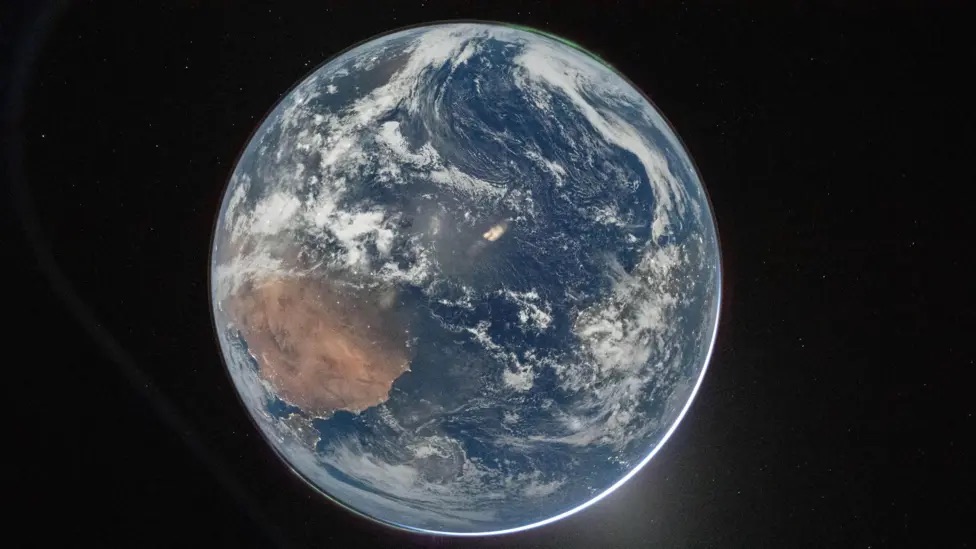
NASA has released the first high-resolution images of Earth taken by astronauts aboard Artemis II as they travel toward the Moon.
The images were captured by mission commander Reid Wiseman after the crew completed a critical engine burn that placed their Orion spacecraft on a trajectory toward the Moon.

Wiseman also took this picture, titled Artemis II Looking Back at Earth, from one of the Orion spacecraft’s four main windows
At the time of capture, the spacecraft was about 142,000 miles from Earth and 132,000 miles from the Moon, marking the halfway point of the journey.

Another image taken by the crew shows the divide between night and day, known as the terminator, cutting across Earth
One image, titled Hello, World, shows Earth glowing against the darkness of space, with the Atlantic Ocean dominating the view. The western Sahara and the Iberian Peninsula appear on one side, while eastern South America is visible on the other. The planet Venus can also be seen shining in the distance.

Lights twinkle in the nighttime as the Earth completely occludes the Sun
Astronaut Christina Koch said the crew felt a collective “expression of joy” upon reaching the milestone just over two days after launch.
Another image shows the boundary between day and night on Earth, known as the terminator, cutting across the planet’s surface. A separate shot captures Earth almost entirely in darkness, with city lights visible across continents.
The mission marks the first time since Apollo 17 that humans have traveled beyond Earth’s orbit. The crew launched from Kennedy Space Center and are expected to loop around the far side of the Moon before returning to Earth.
According to astronaut Jeremy Hansen, the crew were “glued to the windows” after the maneuver, capturing images as Earth receded into the distance.
The mission is scheduled to pass behind the Moon on April 6 and return with a Pacific Ocean splashdown on April 10.

Then and now: Earth, as seen in 2026 (left) and 1972 (right)