The reported killing of Iran’s supreme leader Ali Khamenei has intensified deliberations within the clerical establishment over his successor. One figure expected to play a prominent role is Hassan Khomeini, grandson of Islamic Republic founder Ruhollah Khomeini.
Position and Influence
Hassan Khomeini, 53, is the most publicly visible of Ruhollah Khomeini’s 15 grandchildren. He serves as custodian of his grandfather’s mausoleum in southern Tehran, a symbolically powerful role. He has never held formal government office.
He is widely viewed as relatively moderate within Iran’s clerical hierarchy and maintains ties with reformist figures including former presidents Mohammad Khatami and Hassan Rouhani.
Some Iranian politicians see him as a counterweight to hardliners aligned with Khamenei’s son, Mojtaba Khamenei.

Hassan Khomeini , a grandson of Iran’s Ayatollah Ruhollah Khomeini looks on as he waits to meet Sri Lankan Prime Minister Ranil Wickremesinghe during his visit in Colombo, Sri Lanka July 12, 2016. REUTERS/Dinuka Liyanawatte
Reformist Leanings and Public Positions
While loyal to the Islamic Republic, Hassan Khomeini has occasionally criticized authorities:
In 2021, he rebuked the Guardian Council for barring reformist candidates, a move that cleared the path for hardliner Ebrahim Raisi. He called for transparency following the 2022 death of Mahsa Amini, which triggered nationwide protests. He has spoken about economic hardship under sanctions and supported the 2015 nuclear agreement negotiated under Rouhani.
At the same time, he has defended the system during periods of unrest, criticized anti-Khamenei chants, and participated in pro-government events.
Clerical Status and Political Obstacles
Hassan Khomeini holds the rank of Hojatoleslam, below Ayatollah. In 2016 he was disqualified from running for the Assembly of Experts, the body responsible for appointing the supreme leader. The decision was widely interpreted as limiting reformist influence.
He has at times signaled that the military, including the Islamic Revolutionary Guards Corps (IRGC), should avoid political involvement, though he maintains working ties with the institution.

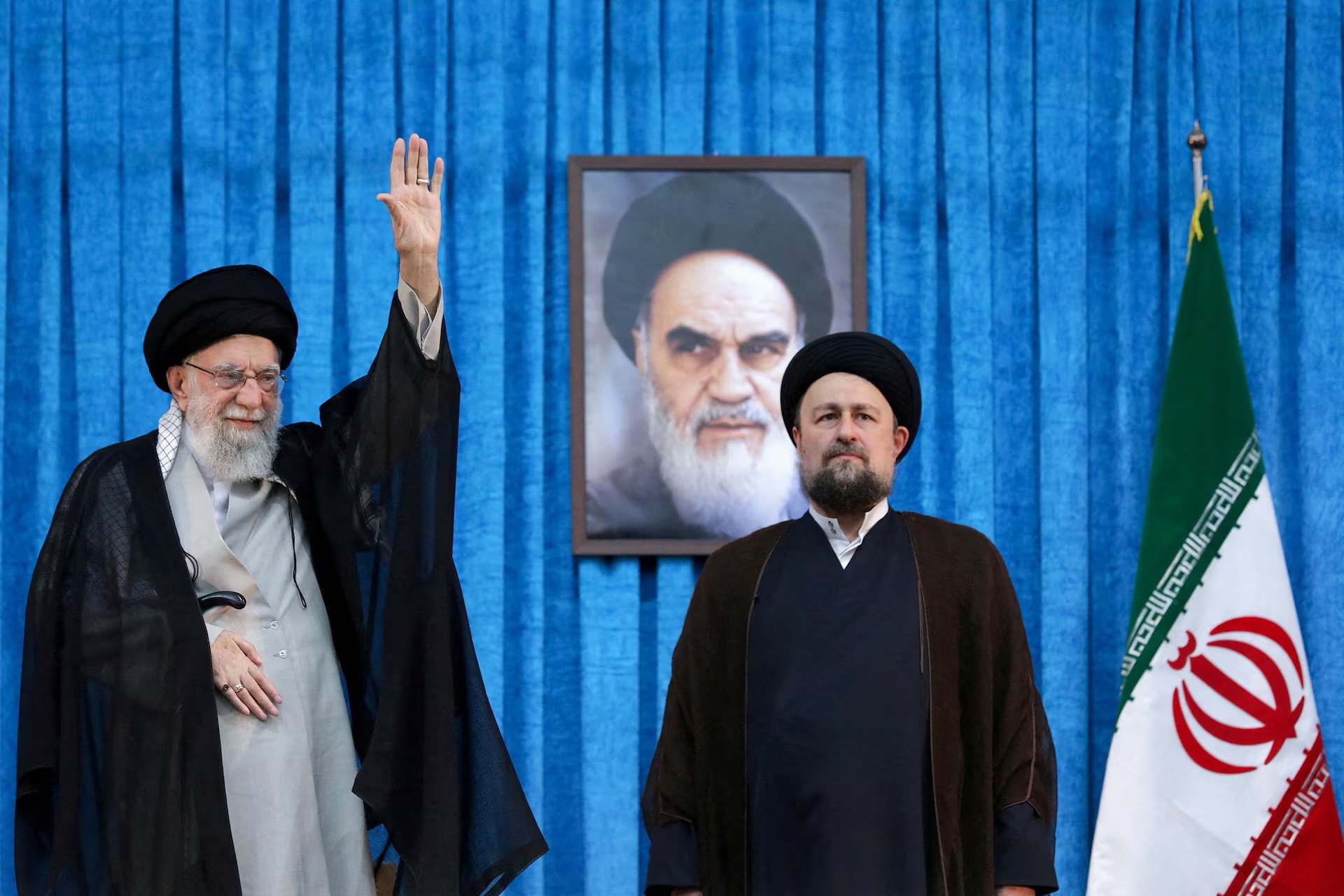
Iran’s Supreme Leader Ayatollah Ali Khamenei and Ayatollah Ruhollah Khomeini’s grandson, Hassan Khomeini look on as they visit the shrine of the leader of Iran’s 1979 Islamic Revolution, Ayatollah Ruhollah Khomeini, in southern Tehran, Iran, January 31, 2026. Office of the Iranian Supreme Leader/WANA (West Asia News Agency)/Handout via REUTERS ATTENTION EDITORS
Ideological Position
He has described Israel as an illegitimate regime backed by the West and has supported strengthening Muslim unity against Zionism. During last year’s conflict with Israel, he publicly praised Khamenei’s leadership.
Fluent in Arabic and English, and educated in Islamic theology in Qom, Hassan Khomeini represents a figure combining establishment legitimacy with reformist associations.
With Khamenei’s death creating a leadership vacuum, his name is expected to feature prominently in deliberations by the Assembly of Experts over the future direction of the Islamic Republic.