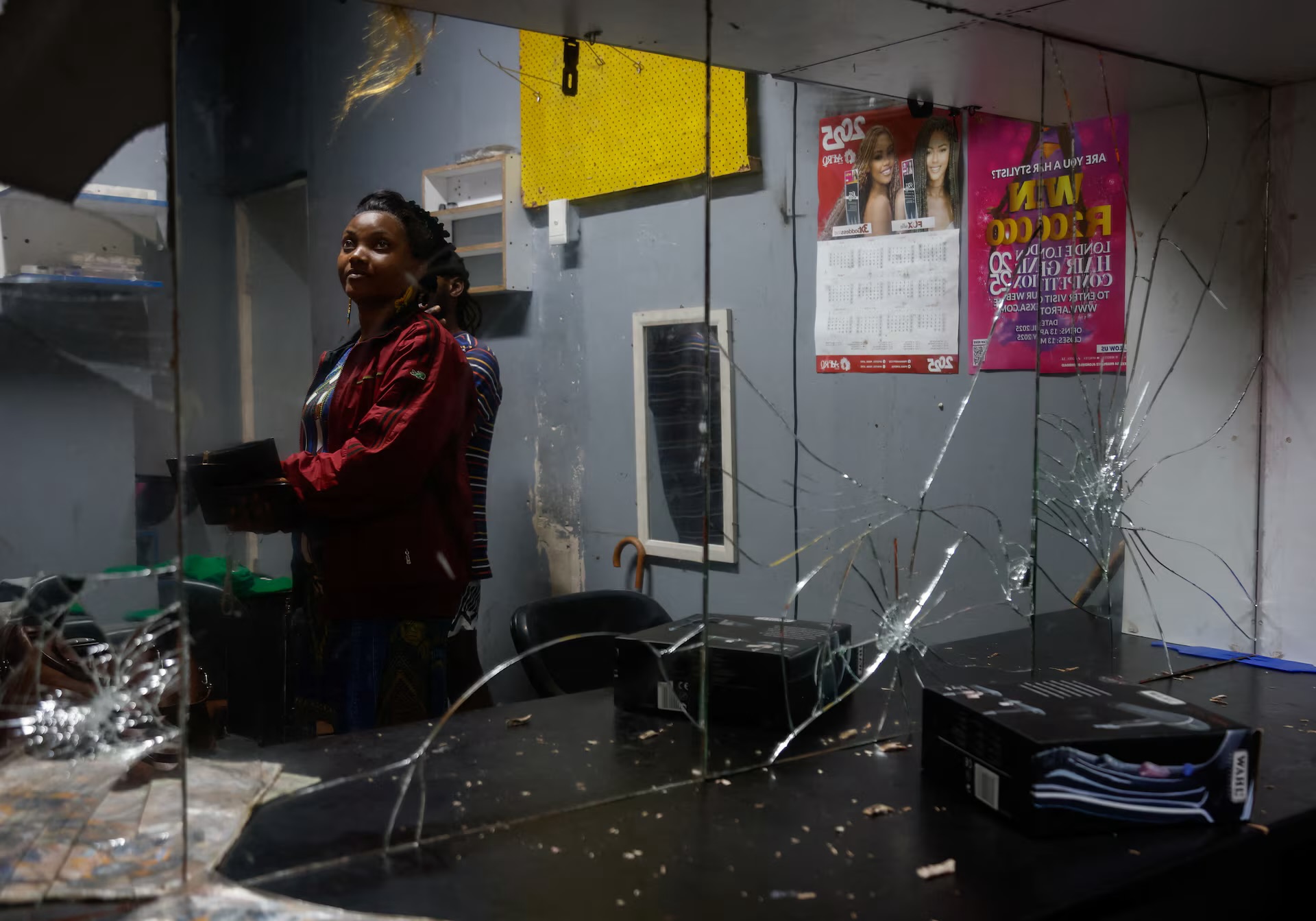
When 33-year-old Princess Adjei opened her dream hair salon in central Durban last November, she believed she was building a future in the only country she had ever truly known.
Born in Ghana but raised in South Africa from the age of two, Adjei attended local schools, speaks fluent Zulu, and has spent almost her entire life in the country. For years, she rarely considered herself a foreigner.
That changed dramatically in May when anti-migrant protests swept through parts of Durban, leaving businesses destroyed, families displaced, and migrants living in fear.
On May 18, demonstrators involved in an anti-immigration march reportedly broke into Adjei’s salon and looted the premises, stripping it of equipment, stock, and furnishings she had spent months building and paying for.

33-year-old Princess Adjei eats a meal on the street where she is staying after her salon was destroyed in a xenophobic attack on May 18, in Durban, South Africa, June 8, 2026. REUTERS/Rogan Ward
Standing among shattered mirrors, damaged furniture, and empty display racks, Adjei described the devastation.
“They took everything,” she said.
“Those were hair pieces I was selling here. There were acrylic nails, six hair dryers, shampoos and other products. Everything is gone.”

33-year-old Princess Adjei stands in her salon, which was destroyed in a xenophobic attack on May 18, in Durban, South Africa, June 9, 2026. REUTERS/Rogan Ward
Business Destroyed, Family Left Homeless
Adjei said she had invested approximately 50,000 rand (more than $3,000) renovating the salon only a few months earlier.
With her business destroyed and income gone, she could no longer afford rent.
Today, she and her 14-year-old son sleep under a blanket on a pavement alongside roughly 200 other migrants outside a Department of Home Affairs office in Durban.
Many are hoping government officials will help confirm their immigration status and provide protection.
“Without the salon, I don’t have money for rent,” she said.
The violence has forced many migrants to flee their homes, businesses, and communities. Some have sought refuge in remote areas, mountains, and open land while others remain stranded on city streets.
Long-Term Residents Suddenly Treated as Outsiders
For many affected migrants, the attacks have been especially painful because they have spent most of their lives in South Africa.
Several migrants interviewed said friends and neighbours who had previously accepted them suddenly turned against them after the protests began.
Adjei recalled returning to her apartment after discovering her salon had been destroyed only to be confronted by a neighbour she once considered a close friend.
The neighbour allegedly demanded to know when she would leave South Africa and return to Ghana.
The encounter left her shocked.
Although born in Ghana, Adjei has visited the country only once and considers South Africa her home.

Foreign nationals sleep on the street after fleeing their homes amid anti-immigrant protests in Durban, South Africa, June 9, 2026. REUTERS/Rogan Ward
Anti-Migrant Movement Denies Xenophobia
The demonstrations were organised by a movement known as March and March, which argues that illegal immigration is placing pressure on jobs, public services, and local communities.
The group’s founder, Jacinta Ngobese, rejected accusations of xenophobia.
She claimed the movement’s focus is on undocumented migration rather than nationality or ethnicity and argued that public anger should be directed at government failures rather than migrants themselves.
However, critics note that anti-migrant demonstrations have frequently been followed by attacks on foreign-owned businesses, looting, property destruction, and violence.
The unrest has reportedly claimed at least five lives and has triggered diplomatic concerns among several African nations.
Migrants Accuse Police of Failing to Protect Them
Many displaced migrants say they received little support from authorities after fleeing violence.
Some reported initially seeking shelter outside Durban’s central police station before being moved between temporary locations.
Several migrants alleged that police later ordered them to leave and used tear gas and rubber-coated bullets against those refusing to move.
Among them was Congolese refugee Tchomba Kasongo, who displayed a wound he claimed resulted from police action.
Durban police denied the allegations.
Police spokesperson Booysie Zungu told reporters that officers did not fire tear gas or rubber bullets at migrants and said no formal complaints regarding the alleged attacks had been filed.
He also stated that victims of looting and violence should report incidents directly to police.
Fear Growing Ahead of Deadline
An additional source of anxiety for migrants is a June 30 deadline issued by some protest groups demanding that undocumented migrants leave the country.
Many legal residents worry they may be targeted regardless of their immigration status.
Among those affected is 25-year-old Congolese refugee Wivene Bahati, who has lived in South Africa since 2011.
She said some South African friends have remained supportive despite the hostility.
One former classmate contacted her after the attacks to check on her wellbeing.
“She felt bad. She asked me if everything was okay,” Bahati said.
Economic Pressures Fuel Tensions
Analysts say anti-migrant sentiment in South Africa is often driven by economic frustrations, unemployment, competition for public services, and housing shortages.
Migrants are frequently blamed for broader social and economic problems, particularly during periods of political uncertainty.
With local elections expected later this year, some observers warn that immigration has become an increasingly sensitive political issue.
However, KwaZulu-Natal Premier Thamsanqa Ntuli rejected suggestions that politics is driving the unrest.
Instead, he argued that the government had failed to properly manage migration for many years.
For migrants like Princess Adjei, however, the political debate offers little comfort.
After spending almost her entire life in South Africa, she now finds herself homeless, unemployed, and being told to leave the only home she has ever known.
Discover more from Niyi Daram
Subscribe to get the latest posts sent to your email.